Published
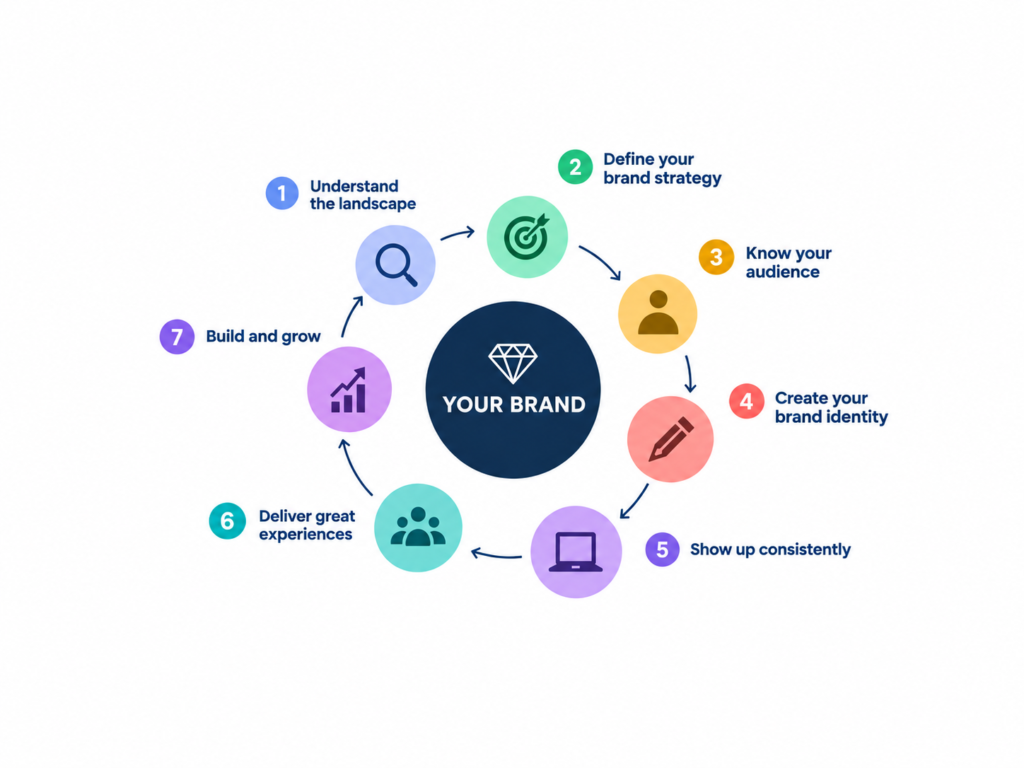
Not long ago, an AI-built brand meant a wobbly logo and a slogan nobody would say out loud. That is no longer a fair picture. Tools can now produce logo directions, colour palettes, messaging and a full set of business documents in minutes. So the question small business owners are asking has changed. It is no longer whether AI can build a brand, but whether the result is good enough to trust. The honest answer is that it is good enough for a lot of the work, and not good enough for the decisions that make a brand yours.
What has changed
Two things have moved together. First, the tools have improved. Producing a first draft of an identity, a set of brand messages or a letterhead no longer needs a specialist or a long wait. Second, small businesses have noticed. Simply Business surveyed 1,842 UK small business owners in summer 2026 and found that 47% now use AI tools, up from 22% the year before.[1] Confidence has not kept pace, though: only 19% described themselves as very confident using AI day to day.[1] Using AI for marketing and brand work has gone from experiment to ordinary practice.
What AI does well now
- Generating options quickly. Logo directions, colour palettes and type pairings that once took weeks of back and forth can be explored in an afternoon.
- Drafting messaging. A first version of a “who we are” statement, brand pillars and a tone of voice gives you something real to react to.
- Producing consistent documents. Business cards, letterheads, brochures and capability statements can all be created from one set of brand decisions, so they match.
- Lowering the barrier. A start-up that could not afford a consultancy can now reach a professional starting point.
For many smaller businesses, that is a genuine change. The first draft is no longer the expensive part.
Where it still needs you
Knowing what makes you different. AI works from what it is given. It cannot know why your best customers chose you, or what you refuse to do, unless someone tells it. That knowledge sits with you.
Distinctiveness. Easy tools make it easy to look like everyone else. In a Vistaprint survey of 300 Australian small business owners who already use AI, 70% said it is becoming easier for brands to look similar as more businesses adopt digital design tools, and only 43% said they felt comfortable launching with AI-only branding.[2] The risk is not poor quality. It is sameness.
Trust. Customers are paying attention. Optimizely’s own survey of 1,000 UK consumers found that 62% say they trust marketing content less since brands began using AI, and 57% say they can usually tell when content is AI-generated. The same research found 72% are more likely to engage with content that feels human.[3] These are perceptions rather than proof of what customers can detect, but they matter either way.
Accountability. If your business publishes it, your business answers for it. We cover this in why approval matters when AI helps with your marketing.
So what does “good enough” really mean?
It helps to separate production from decisions. AI is now good enough for production: drafting, designing, formatting and repeating. It is not a substitute for the decisions that sit underneath: who you serve, what you stand for and what you want to be known for. Get those wrong and AI will simply produce the wrong thing faster, which is the point we make in why more content won’t fix a weak brand.
The businesses that get the most from AI tend to do the thinking first, then use it to do the heavy lifting. The order matters more than the tool.
How we approach it
ELVRA Brand OS is built on that order. Guided questions capture your decisions about your business, customers and values. AI then turns those decisions into identity, messaging and documents, all from the same source, so they stay consistent. You review and approve everything before it is used, and higher tiers add expert human support. You can see what is included on our pricing page.
A quick test before you rely on an AI-built brand
- Could a customer explain what you do and why you are different, in one sentence?
- Would your brand still be recognisable with the logo covered?
- Do your website, documents and social posts sound like one business?
- Has a person checked and approved it?
If the answer to all four is yes, AI has done its job. If not, the gap is almost certainly in the thinking, not the tool.
References
- Simply Business (2026). AI use among UK small businesses more than doubles in a year, 8 September 2026, based on the 2026 SME Insights Report (1,842 UK small businesses, surveyed 30 July to 7 August 2026). simplybusiness.co.uk.
- IT Brief Australia (4 February 2026). Aussie small firms blend AI speed with human branding, reporting Vistaprint research on Australian small and medium-sized businesses. itbrief.com.au. The survey covered 300 Australian small business owners who already use AI, and was run by a company that sells design and print tools.
- Optimizely (22 September 2026). Six in 10 consumers say AI has made brand marketing less trustworthy (1,000 UK consumers and 100 marketers). optimizely.com. This is the vendor’s own survey and reports what consumers say, not independently tested behaviour.
This article is general information, not legal or professional advice.