Published
Why Brand Consistency Beats AI Speed Every Time
Most small businesses now use AI for content generation. Adoption jumped from 23% in 2023 to 58% in 2025. The tools promise speed. They deliver volume. Speed without structure creates a different problem.
AI generates posts faster than any team can match. Scattered messaging erases recognition. Fifty disconnected pieces teach your audience to forget you.
Brand consistency wins. Research shows consistent branding can increase revenue by up to 23%. Platform infrastructure beats publishing volume every time.
AI Adoption Without Brand Foundations
More than half of small businesses now use AI for content. Marketing is the fastest entry point for AI in small firms. Businesses use it to write emails, social posts, marketing copy and product descriptions. The numbers climb monthly.
The problem sits upstream. AI may generate sentences inconsistent with your brand voice. Consistency across multiple pieces remains a challenge. Vague prompts and messy source documents drive the chaos teams see.
Without brand foundations, AI tools amplify disorder. One channel emphasises features. Another talks values. A third shifts tone entirely. The output multiplies. The message fractures.
Businesses drown in their own content libraries. Hundreds of assets sound like they came from different companies. No customer can form a clear memory from that noise.
We built ELVRA to solve this. Brand clarity must come before content creation. The platform guides you through strategic discovery first. Then it produces everything inside those boundaries. You approve before publication, so the brand stays yours.
When AI works from a single foundation, volume becomes an asset. Every piece reinforces the same position, tone and visual system. Recognition compounds instead of scattering.
Inconsistency Erodes Trust and Recognition
Trust drives purchasing decisions. Eighty-one percent of consumers require it before buying from a brand. Customers who experience inconsistent messaging develop lower trust. They also show reduced loyalty.
Misalignment damages your reputation. Twenty-one percent of customers point to consistent email formatting as a trust signal. For high-value clients, small inconsistencies trigger doubt about professionalism.
What builds recall is specificity paired with repetition of the same idea. Publishing volume without repetition of identity achieves nothing. Prospects need to see the same positioning, tone and visual system each time they encounter you.
Most AI strategies fail here. Teams mistake activity for strategy. Content gets generated. Nobody asks whether it reinforces or contradicts what came before.
The economics of scattered messaging work against you. You pay to produce content that confuses rather than clarifies. Customers see mixed signals and move on to brands with sharper identities.
We believe infrastructure fixes this. Define your positioning once. Lock it into every workflow. Then let AI produce inside those parameters. Volume becomes useful when it builds memory instead of noise.
Platform Infrastructure Anchors Every Output
You need infrastructure to maintain brand consistency at scale. Strategic foundations matter. So do documented standards and governed creation systems.
Strategic foundations define who you serve and what differentiates you. Documented standards translate strategy into visual identity, messaging architecture and tone of voice. Governed creation draws every asset from that single source.
The challenge is control. You must review, approve, publish and govern AI content without losing accuracy or accountability. Governance needs design before content volume grows too large. Infrastructure solves this before chaos compounds.
The right approach trains AI on your brand pillars, then locks those inputs into every workflow. Content leaves the system only when it matches your approved positioning, voice and visual standards.
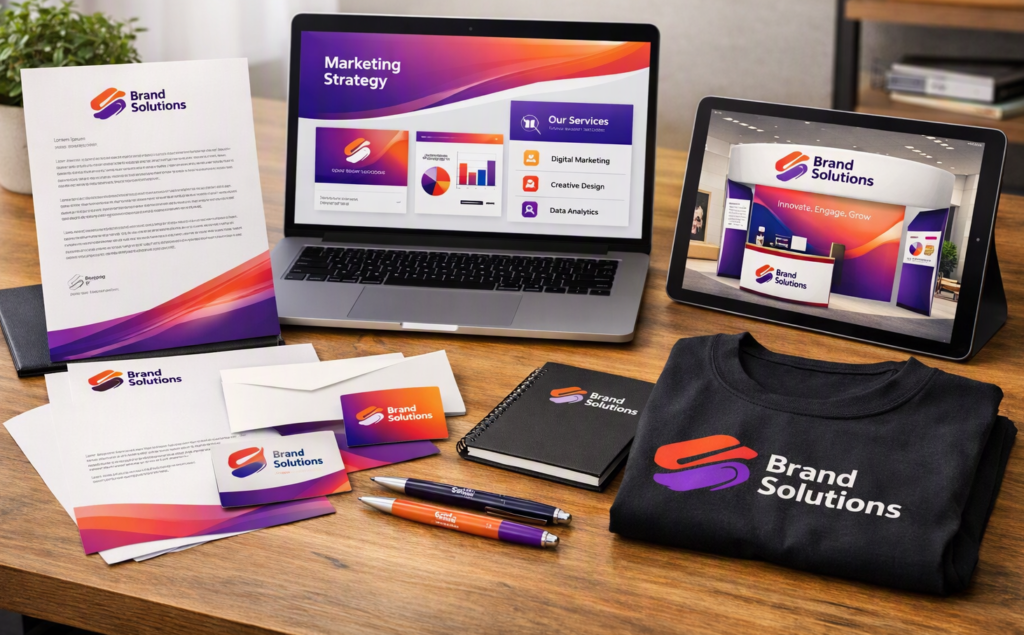
ELVRA operates this way by design. The platform builds your foundations through guided questions. It generates every asset inside those parameters: business cards, pitch decks, social posts, thought leadership articles. All consistent because they draw from the same strategic core.
You approve everything before it goes live. The system maintains standards. Your team gains speed without sacrificing coherence. That discipline separates brands that scale from brands that scatter.
Recognition Requires Spaced Repetition
A customer needs to encounter your brand position multiple times, but not all at once. Seeing it once weekly for eight weeks creates stronger memory than eight times in one week. Spacing matters. So does consistency.
Companies with high brand consistency scores achieve 2.4 times the average growth rate compared to inconsistent brands. The gap comes from repeating the same identity across every touchpoint.
AI speed means nothing if customers cannot recognise you. Build the infrastructure first. Then let AI produce within it. Your posts, decks and documents reinforce one coherent system instead of resetting progress each month.
We built ELVRA to close this gap. Strategic clarity comes first. Governed content follows. Momentum compounds recognition instead of scattering it.
The platform defines your foundations: purpose, archetype, messaging pillars, visual identity. Every asset is generated inside those parameters. You approve before publication. The brand stays consistent. The volume stays manageable.
This is how smaller businesses compete with companies ten times their size. Not by producing more, but by producing coherently. Each piece builds on the last. Recognition becomes inevitable.
Visit https://elvrabrandos.com to build brand infrastructure that turns volume into recognition.
References
1. Small business AI adoption statistics for 2026
2. Brand consistency: key to trust & recognition in business
3. What are The Key Quality Control Measures for AI-Generated Content?
4. Brand consistency guide: why it builds customer trust
5. The Hidden Cost of Inconsistent Brand Messaging
6. Brand Recall: Why Customers Remember Some Brands and Forget Yours
7. The Content Review Problem Created by Generative AI
8. 40 Brand Voice Consistency Statistics in eCommerce in 2026
Your scores at a glance
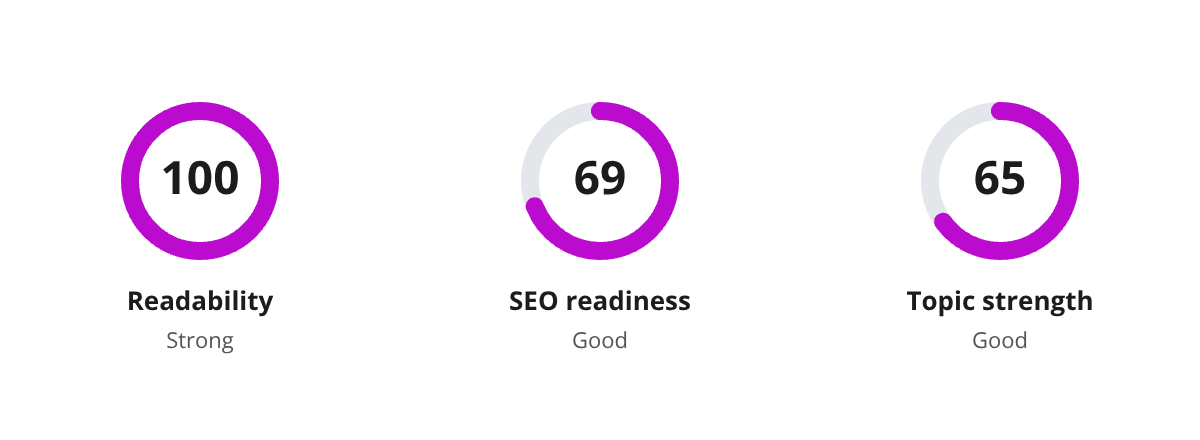
Out of 100. 80 and above is Strong, 60 to 79 is Good, below 60 needs work. Topic strength is the average of how timely the topic is and how well it covers what the leading articles cover. The detail follows.
The scores in detail
Readability: 100/100 (Strong). Reading grade 9.4 against a target of 12 or lower (Automated Readability Index, the method Hemingway’s checker uses). Average sentence 8 words; 4% of sentences are very hard to read; 1 passive phrases; 4 adverbs. Calculated, not estimated.
SEO readiness: 69/100 (Good). On-page checks 85/100, search-results fit 45/100. This is an on-page readiness score, not a prediction of ranking. SERP is dominated by marketing guides, branding fundamentals, and AI content strategy articles. The article partially fits but faces strong competition from established brands and comprehensive guides.
Trending topic: 72/100 (Good). Momentum: rising. AI content generation and brand consistency intersection is actively discussed in recent months. Multiple authoritative sources covering AI’s impact on branding signal rising momentum. A researched estimate.
Market coverage: 58/100 (Needs work). Covers 5 of 8 key points. Missing: AI brand voice training methods; Specific governance tools and workflows; Case studies with measurable outcomes. Article covers core concepts but lacks practical implementation details, tools, and real-world examples that leading content provides for small business audiences. A researched estimate.
The scores are a hygiene check, not a guarantee of ranking. Draft for review: it goes to a named human reviewer and then to you for approval. Nothing is published until you approve it.
Suggested search listing
Primary keyword: brand consistency
Secondary keywords: AI content tools, brand infrastructure, brand recognition
SEO title: Why Brand Consistency Beats AI Speed Every Time
Meta description: AI delivers speed. Without brand consistency, volume erodes recognition. Infrastructure wins. Here is how to build yours properly.
URL slug: /brand-consistency-beats-ai-speed
Quality gate report
Status: 3. Automatic checks (blockers to clear). 1 blocker, 4 warnings. This piece cannot go to the client until every blocker is fixed or overridden by a named approver with a written reason. The scores are a hygiene check on readability, on-page SEO and sourcing, not a guarantee of ranking.
Readability
| Check | Result | Note |
| Reading grade 9.4 (target 12) | Pass | At or below target. |
| Very hard sentences: 4 | BLOCKER | Each one is listed below; shorten or split it. |
| Hard sentences: 12 (12%) | Warning | No more than 10% of sentences. |
| Passive voice: 1 (1%) | Pass | No more than 10% of sentences. |
| Adverbs: 4 | Pass | Flagged for the reviewer; no hard limit. |
| Average sentence length 8 words | Pass | 20 words or fewer. |
| Paragraphs over 4 sentences: 5 | Info | Shorter paragraphs read better on screen. |
Sentences to look at
- hard to read: Businesses use it to write emails, social posts, marketing copy and product descriptions.
- hard to read: Twenty-one percent of customers point to consistent email formatting as a trust signal.
- hard to read: Strategic foundations define who you serve and what differentiates you.
- very hard to read: Documented standards translate strategy into visual identity, messaging architecture and tone of voice.
- hard to read: You must review, approve, publish and govern AI content without losing accuracy or accountability.
- hard to read: Content leaves the system only when it matches your approved positioning, voice and visual standards.
- very hard to read: It generates every asset inside those parameters: business cards, pitch decks, social posts, thought leadership articles.
- hard to read: That discipline separates brands that scale from brands that scatter.
- hard to read: Companies with high brand consistency scores achieve 2.4 times the average growth rate compared to inconsistent brands.
- hard to read: Your posts, decks and documents reinforce one coherent system instead of resetting progress each month.
- very hard to read: The platform defines your foundations: purpose, archetype, messaging pillars, visual identity.
- passive voice: Every asset is generated inside those parameters.
On-page SEO
| Check | Result | Note |
| Primary keyword chosen | Pass | “brand consistency” |
| SEO title contains the keyword | Pass | Why Brand Consistency Beats AI Speed Every Time |
| SEO title is 50 to 60 characters (47) | Warning | |
| Meta description contains the keyword | Pass | |
| Meta description is 140 to 160 characters (130) | Warning | |
| Exactly one H1 (the title), containing the keyword | Pass | |
| Heading structure: 4 subheadings, no skipped levels | Pass | |
| Keyword or a variant in at least one H2 | Pass | |
| Keyword in the first 100 words | Pass | |
| Keyword in the URL slug | Pass | /brand-consistency-beats-ai-speed |
| Keyword not stuffed (0.7% of words) | Pass | |
| Length: 811 words (minimum 700) | Pass | |
| Length: 811 words (maximum 850) | Pass | |
| URL slug is short, lowercase and hyphenated | Pass | /brand-consistency-beats-ai-speed |
| Internal links (at least 2) | Pass | The client’s own site is not connected yet, so add 2 links to their pages or articles when it is published. |
| External links to authoritative sources: 8 (at least 2); all opened and confirmed live | Pass | Broken links are not allowed: only pages the platform opened are listed. |
| Images: descriptive alt text and a featured image | Pass | Added when the piece is published to the website. |
| No overlap with the client’s existing articles | Pass | |
| Article schema fields ready (headline, author, dates, image) | Pass | Published as JSON-LD with the article. |
Facts and opinion rules
| Check | Result | Note |
| Claims table: 14 claims, 0 unverified or contradicted | Pass | Every claim has a live source. |
| Verified sources: 8 (at least 3) | Pass | |
| Statistics older than 24 months and undated in the text: 2 | Warning | Research shows consistent branding can increase revenue by up to 23% | Companies with high brand consistency scores achieve 2.4 times the average growth rate compared to inconsistent brands |
| Named author | Pass | ELVRA Brand OS |
| Personal anecdotes needing the author’s confirmation: 0 | Pass |
Claims table
Every checkable claim in the piece, its source and the result. The source pages were opened by the platform in a separate pass from the drafting, so the draft is not marking its own work.
| Claim | Type | Source | Publisher and date | Supports | Status | Checked | Action |
| Most small businesses now use AI for content generation | Statistic | Small business AI adoption statistics for 2026 https://capsulecrm.com/blog/small-business-ai-adoption-statistics/ | Capsule CRM, 2025 | Yes | Verified | ELVRA automated source check (separate pass), 2026-11-09 | Keep |
| Adoption jumped from 23% in 2023 to 58% in 2025 | Statistic | Small business AI adoption statistics for 2026 https://capsulecrm.com/blog/small-business-ai-adoption-statistics/ | Capsule CRM, 2025 | Yes | Verified | ELVRA automated source check (separate pass), 2026-11-09 | Keep |
| Research shows consistent branding can increase revenue by up to 23% | Statistic | Brand consistency: key to trust & recognition in business https://www.leat.com/resources/insights/brand-consistency | Leat, 2024 | Yes | Verified | ELVRA automated source check (separate pass), 2026-11-09 | Keep |
| Fifty-five percent of small businesses use AI for content generation, including emails, social posts, marketing copy, and product descriptions | Statistic | Small business AI adoption statistics for 2026 https://capsulecrm.com/blog/small-business-ai-adoption-statistics/ | Capsule CRM, 2025 | Yes | Verified | ELVRA automated source check (separate pass), 2026-11-09 | Keep |
| Marketing is the fastest entry point for AI in small firms | Statistic | Small business AI adoption statistics for 2026 https://capsulecrm.com/blog/small-business-ai-adoption-statistics/ | Capsule CRM, 2025 | Yes | Verified | ELVRA automated source check (separate pass), 2026-11-09 | Keep |
| AI may generate sentences inconsistent with a brand’s voice, and consistency across multiple pieces remains a challenge | Other | What are The Key Quality Control Measures for AI-Generated Content? https://business901.com/blog1/what-are-the-key-quality-control-measures-for-ai-generated-content/ | Business901, 2024 | Yes | Verified | ELVRA automated source check (separate pass), 2026-11-09 | Keep |
| Eighty-one percent of consumers state that trust is a prerequisite for purchasing from a brand | Statistic | Brand consistency guide: why it builds customer trust https://exclaimer.com/blog/brand-consistency-supercharging-trust/ | Exclaimer, 2025 | Yes | Verified | ELVRA automated source check (separate pass), 2026-11-09 | Keep |
| Customers who experience inconsistent messaging develop lower trust levels and reduced brand loyalty | Other | The Hidden Cost of Inconsistent Brand Messaging https://planleft.com/blog/the-hidden-cost-of-inconsistent-brand-messaging/ | Plan Left, 2024 | Yes | Verified | ELVRA automated source check (separate pass), 2026-11-09 | Keep |
| Twenty-one percent specifically point to consistent formatting across emails as a trust signal | Statistic | Brand consistency guide: why it builds customer trust https://exclaimer.com/blog/brand-consistency-supercharging-trust/ | Exclaimer, 2026 | Yes | Verified | ELVRA automated source check (separate pass), 2026-11-09 | Keep |
| Customers rarely remember a business from a single interaction; recognition builds gradually through repeated exposure | Other | Why Customers Remember Brands https://www.brandimpact.com.au/why-customers-remember-brands/ | Brand Impact, 2024 | No | Opinion | ELVRA automated source check (separate pass), 2026-11-09 | Reword |
| What builds recall is specificity paired with repetition of the same idea | Other | Brand Recall: Why Customers Remember Some Brands and Forget Yours https://www.unlimitedconversions.com/articles/brand-recall-memory/ | Unlimited Conversions, 2024 | Yes | Verified | ELVRA automated source check (separate pass), 2026-11-09 | Keep |
| The challenge is how to review, approve, publish, and control AI-generated content without losing accuracy, brand consistency, or accountability; governance needs design before content volume grows too large | Other | The Content Review Problem Created by Generative AI https://twendeesoft.com/blog/the-content-review-problem-created-by-generative-ai | Twendee, 2024 | Yes | Verified | ELVRA automated source check (separate pass), 2026-11-09 | Keep |
| A customer needs to encounter your brand position multiple times, but not all at once; seeing it once weekly for eight weeks creates stronger memory than eight times in one week | Other | Brand Recall: Why Customers Remember Some Brands and Forget Yours https://www.unlimitedconversions.com/articles/brand-recall-memory/ | Unlimited Conversions, 2024 | Yes | Verified | ELVRA automated source check (separate pass), 2026-11-09 | Keep |
| Companies with high brand consistency scores achieve 2.4 times the average growth rate compared to inconsistent brands | Statistic | 40 Brand Voice Consistency Statistics in eCommerce in 2026 https://www.envive.ai/post/brand-voice-consistency-statistics-in-ecommerce | Envive, 2024 | Yes | Verified | ELVRA automated source check (separate pass), 2026-11-09 | Keep |
Reviewer checklist
Author: ELVRA Brand OS. The reviewer ticks each item, then signs off in the admin quality queue. The reviewer cannot be the process that drafted the piece.
- [ ] Tone and voice match the client’s brand.
- [ ] The argument is sound and the author’s opinion is accurately represented.
- [ ] The claims table has no open items.
- [ ] Manual SEO tool checks are done (or marked not applicable, with a reason).
- [ ] No confidential or client-sensitive information is included without approval.
Manual SEO tool checks
Required before the piece is published to a live site. Record the result or paste a link.
- [ ] Yoast SEO or Rank Math (free): Run on the staged WordPress post, if there is a staging site.
- [ ] Google PageSpeed Insights or Lighthouse: Page speed, mobile usability, basic SEO and accessibility.
- [ ] Google Rich Results Test and Schema Markup Validator: Confirm the structured data is valid.
- [ ] Screaming Frog (free to 500 URLs): Broken links, missing titles and metas, duplicates. Site level: run periodically.
- [ ] Ahrefs Webmaster Tools (verified sites): Site audit and backlinks.
- [ ] Google Search Console: After launch: indexing, queries and clicks.
Article schema (for the website)
{
“@context”: “https://schema.org”,
“@type”: “Article”,
“headline”: “Why Brand Consistency Beats AI Speed Every Time”,
“author”: {
“@type”: “Person”,
“name”: “ELVRA Brand OS”
},
“datePublished”: “set when published”,
“image”: “set when published”
}
Pages compared in the scoring research
1. Brand Consistency: What It Is, Why It Matters, & How to Achieve It
2. What Is Brand Consistency and Why Does It Matter?
3. Brand Consistency: A Complete Guide – Marq
4. What is Brand Consistency & Why is it Important? – Tailor Brands
5. The Importance of Brand Consistency – Forbes
6. How AI Is Transforming Brand Identity and Consistency
7. AI and Brand Consistency: Balancing Automation with Authenticity
8. Maintaining Brand Consistency in the Age of AI Content
9. The Challenge of Brand Voice Consistency When Using AI
10. How to Maintain Brand Consistency With AI Content Creation
11. Brand Guidelines in the AI Era: What SMBs Need to Know
12. AI Content Creation: Keeping Your Brand Voice Consistent